Formulating with freeze-dried fruit requires more than choosing a fruit variety that tastes good. Food brands also need to know whether the ingredient will perform reliably across 10,000 units, survive the processing line, support a clean-label story, and remain available at the same specification and lead time six months later.
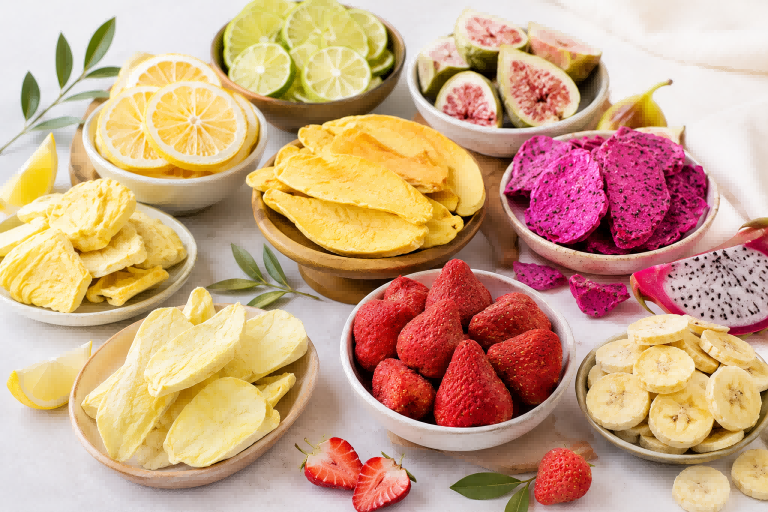
Freeze-dried fruit has become a valuable ingredient across snack bars, cereals, chocolate, confectionery, powders, and functional food products. However, the distance between “it sounds like a great ingredient” and “it works in our formulation at scale” is larger than many brands realize during initial sampling. This practical freeze-dried fruit formulation guide explains application-specific ingredient behavior, the specifications that influence performance, and the supply factors food brands should verify before commercial scale-up.
1. Why Freeze-Dried Fruit Behaves Differently in Every Application
Freeze-drying removes water through sublimation — the direct transition from ice to vapor under vacuum — without the high-temperature exposure that characterizes conventional drying. The result is a product whose cellular architecture is largely intact: the original shape, color pigments, aromatic volatiles, and structural porosity are preserved in a way that heat-based drying cannot achieve.
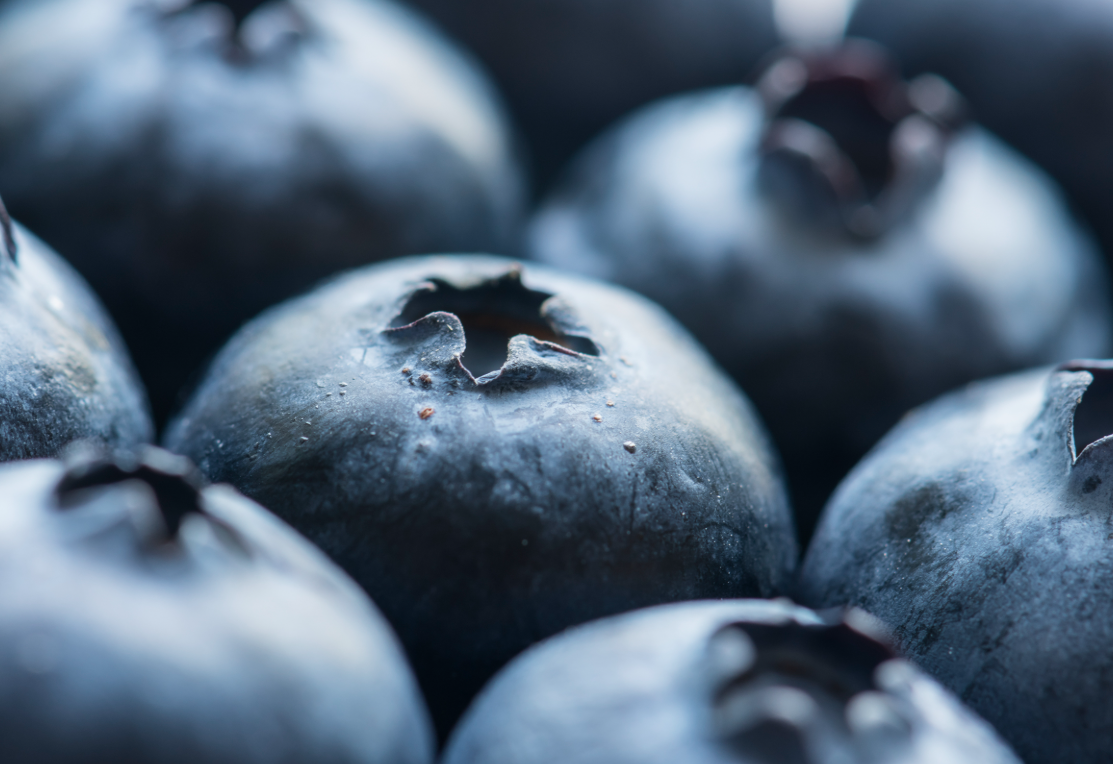
That preserved porosity is what makes freeze-dried fruit behave so differently depending on what it is mixed with, coated in, or added to. The same structural openness that allows a freeze-dried blueberry to rehydrate almost instantly in milk also makes it highly susceptible to moisture migration in a high-aw environment — like a cream filling or a fresh yogurt product. The same concentrated flavor that makes freeze-dried raspberry powder an exceptional natural colorant in a dry protein blend can become overwhelming if the powder ratio is not calibrated to the application.
Understanding these behaviors is the entry point for using freeze-dried fruit well. The failure mode for most first-time applications is not choosing the wrong variety — it is choosing the wrong format, or the wrong particle specification, for what the product actually needs to do.
2. The Application Map: Where Freeze-Dried Fruit Works — and Why
Snack Bars, Granola, and Cereal Inclusions
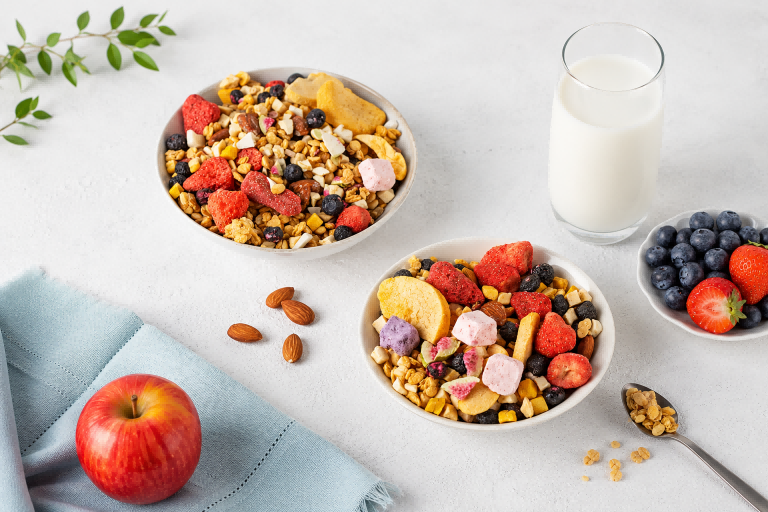
This is the highest-volume application category for industrial freeze-dried fruit, and the one where ingredient behavior is most consistently misunderstood at the specification stage. The common mistake: sourcing freeze-dried fruit pieces based on moisture content and price, without specifying structural integrity or rehydration behavior for the matrix they will be embedded in.
In a low-moisture cereal or granola bar — water activity below 0.5 — freeze-dried pieces perform well if their moisture ceiling is properly controlled (typically below 3%). The porosity that makes them crisp also makes them excellent flavor-release vehicles: the concentrated aromatic compounds in freeze-dried strawberry or mango are detected by consumers as “real fruit” intensity in a way that dried fruit cannot replicate. Color retention across shelf life is equally important here; freeze-dried fruit holds its natural pigment far more effectively than conventionally dried alternatives because the process avoids the Maillard browning that heat causes.
The complication arises in bars or cereals with higher moisture content in the matrix — oat clusters with honey binding, for example, or protein bars with humectants in the recipe. In these cases, the hygroscopic nature of freeze-dried fruit works against you: pieces begin absorbing moisture from the surrounding matrix within weeks, losing crunch and becoming chewy or sticky. Addressing this requires either reformulating the matrix water activity, applying a moisture-barrier coating to the fruit pieces before incorporation, or shifting to a granule format rather than whole pieces.
The right specification for snack bar applications: moisture ≤2.5%, uniform particle size with sieve analysis data, structural integrity rating sufficient for blending, and per-lot water activity verified before shipment.
Chocolate and Confectionery: The Fastest-Growing Format
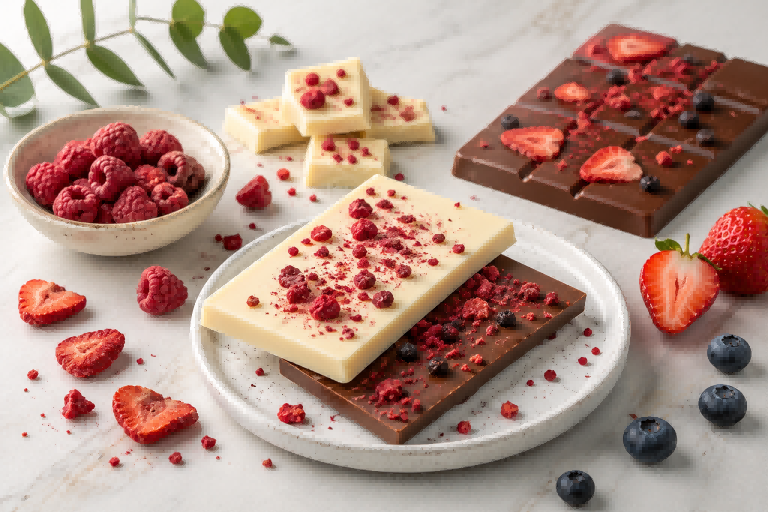
No application in the freeze-dried fruit category has grown as rapidly in the past four years as chocolate inclusion — freeze-dried pieces, slices, or whole fruits incorporated into or deposited on chocolate products. The commercial logic is strong: a two or three-ingredient label, a premium visual presentation, and a sensory contrast between brittle fruit and dense chocolate that no other ingredient can deliver.
But the technical requirements of this application are more demanding than they appear at the consumer end. Water activity in the freeze-dried piece must be low enough that moisture migration into the chocolate is negligible over the product’s shelf life — typically a target below 0.3 aw in the finished inclusion. This is not simply a function of moisture percentage; it depends on the hygroscopic character of the specific fruit (mango and banana are notably more hygroscopic than raspberries or strawberries), the ambient humidity during packaging, and the packaging film’s water vapor transmission rate.
The second critical variable is structural integrity under thermal processing. Chocolate enrobing involves depositing fruit pieces into a flow of tempered chocolate, which adds thermal and physical stress. Pieces that are too fragile will fracture during processing and create a visual defect in the finished bar. This requires the supplier to have done process development work around freeze-drying parameters — pre-freezing rate, shelf temperature profile, secondary drying duration — specific to each variety’s cell wall structure, not just applied a generic drying recipe.
At FD Planet, producing across seven fruit varieties including strawberry, blueberry, raspberry, mango, pineapple, apple, and banana on purpose-built production lines allows us to calibrate cycle parameters per variety, not per production run. The difference is visible in structural consistency batch to batch — and it is a difference that only becomes clear to a product developer the third or fourth time they scale up production and need the same piece geometry they approved at the sample stage.
Powders: Natural Color, Concentrated Flavor, Clean Label
Freeze-dried fruit powder occupies a different functional space than whole-piece or granule formats. The primary value it delivers is flavor intensity and color contribution per gram — both significantly higher than fresh fruit equivalents because of the concentration effect of removing water without heat degradation.
In practical terms, freeze-dried strawberry powder provides a natural red-pink pigment alongside genuine strawberry flavor character — a clean-label replacement for synthetic colorants in yogurt coatings, confectionery dusting, smoothie bases, and protein shake blends. The regulatory path for using freeze-dried fruit powder as a natural colorant is substantially simpler than for standardized plant extracts or approved color additives, which matters for brands selling into multiple markets with different regulatory frameworks.
The key technical parameter for powder applications is particle size and its impact on dissolution behavior. A coarse grind (100–300 micron) retains some texture and rehydrates quickly in liquid applications. A fine grind (below 75 micron) dissolves more smoothly but generates more surface area, which accelerates oxidation if packaging is not optimal. Specifying both the particle size distribution and the packaging atmosphere (nitrogen flush) is essential for powder procurement — both affect flavor stability across shelf life.
Note on supplement-adjacent applications: if your product makes any structure-function claim based on the fruit’s vitamin or antioxidant content, verify per-lot nutrient density with your supplier. Water removal concentrates these compounds, but the actual values vary by raw material maturity and oxidation during processing. Published nominal values are not a substitute for verified CoA data.
3. Supply Reliability: What Brands Actually Depend On
Application performance is the visible part of a freeze-dried fruit supplier relationship. Supply reliability is the part that brands discover too late when it is absent.
Between 2021 and 2023, the freeze-dried fruit market experienced a period of significant supply disruption. Raw material shortages in key growing regions, energy cost increases that affected production economics for lyophilization-intensive operations, and demand surges from premium food category growth combined to stretch lead times and strain supplier allocations globally. Brands that had positioned freeze-dried fruit as a hero ingredient in an SKU — and had communicated it on the packaging — found themselves either reformulating under timeline pressure or paying spot-market premiums to secure volume.
What differentiated suppliers who maintained consistent delivery was not their certification stack. It was manufacturing depth: installed production capacity across multiple independent lines, raw material inventory strategy, and the operational experience to flex through disruption without compromising batch quality.
The Multi-Line Advantage
Running six independent production lines — as at our facility — means scheduled maintenance does not create a supply gap. It means that when one production line is being recalibrated after a product changeover, five continue running. It means that a raw material quality failure in a single incoming lot can be isolated to that line’s schedule without propagating across all customer allocations simultaneously.
Single-line manufacturers — which represent a large portion of the freeze-dried fruit supply market, particularly in the mid-tier — cannot offer this separation. A breakdown, a food safety hold, or a raw material interruption affects 100% of their output simultaneously. For brands with active retail commitments, that is an unacceptable risk profile.
Raw Material Depth and Seasonal Planning
Freeze-dried fruit production is fundamentally agricultural in its constraints. Strawberry harvest windows in major growing regions span weeks, not months. Mango availability fluctuates with climate variability in Southeast Asian growing zones. A supplier with no cold storage capacity or grower relationships is entirely dependent on spot-market availability at peak season — paying premium prices and accepting whatever maturity window the market delivers.
Linyi Tianqin Food Co., Ltd. has been operating food ingredient production since 1997 — beginning in air-dried seasonings before the freeze-drying market reached its current scale. That longevity represents grower relationships predating the commodity price spikes of the past five years, cold storage infrastructure that allows raw material to be purchased at optimal harvest and held to processing schedule, and institutional knowledge about how to manage ingredient quality across variable agricultural seasons.
For a brand sourcing freeze-dried fruit at meaningful volume, these operational realities are the supply chain you are actually buying into — not just the spec sheet.
Specification Flexibility vs. Commodity Listing
One structural advantage of sourcing directly from a manufacturer — rather than through an ingredient trader — is the ability to specify beyond the commodity default. Particle size ranges, moisture ceilings, water activity maximums, packaging atmosphere, and lot size can all be negotiated as contract specifications when the entity you are dealing with has direct control over the production parameters.
Traders who source from multiple small producers cannot offer this. They are selling from an existing product menu. A manufacturer running a purpose-built freeze-drying operation — as opposed to a multi-category ingredient trading desk — can engineer around a brand’s specific application constraints. For product developers who have spent time troubleshooting ingredient behavior in a complex formulation, this distinction is not abstract: it is the difference between being told “our spec is our spec” and having a technical conversation about what actually needs to change to make the product work.
4. What to Verify Before Sourcing at Scale
For brands moving from pilot quantity to commercial volume, the following are the questions worth asking before committing to a supplier:
Production infrastructure: How many independent freeze-drying lines are in operation? What is the installed capacity and typical utilization rate? Is production in a dedicated freeze-drying facility or a multi-category plant?
Per-variety process development: Have cycle parameters been independently optimized for each fruit variety, or is a generic cycle applied? What is the documented moisture variation across batch positions on a single run?
Raw material sourcing: Is raw material purchased on spot or through grower contracts? Is cold storage available for seasonal inventory? What is the incoming inspection protocol, and does it include maturity index measurement?
Per-lot CoA scope: Does the supplier issue CoA per production lot (not per product line), covering moisture content, water activity, color index (L*a*b*), particle size distribution, microbial counts, and pesticide residue panel?
Specification customization: Can particle size, moisture ceiling, packaging format, and lot size be specified as contract parameters? Or does the supplier offer a fixed product menu only?
Factory audit access: Is a direct factory visit available to your quality team, not just a virtual audit of a trading company office? Third-party audit reports from current periods (within 12 months) should be standard.
Continuity planning: What is the contingency protocol for a raw material crop failure or production line shutdown? Has the supplier navigated supply disruptions in the past, and what was their response?
These are not extraordinary requirements. They are the baseline for a supplier relationship built to support a commercial product line rather than a sample evaluation.
Conclusion: Building a Reliable Freeze-Dried Fruit Formulation
Freeze-dried fruit rewards the brands that understand it as an engineering ingredient rather than a commodity input. Its application performance — across snack bars, chocolate inclusions, functional powders, and beyond — is determined by process decisions made in the production facility, not just by the variety name on the packaging. Sourcing it well means finding a manufacturer with the infrastructure, process discipline, and supply chain depth to deliver those decisions consistently, at commercial volume, over the life of a product line.
FD Planet is built for that requirement. With six production lines in a dedicated freeze-drying facility, German-engineered chamber technology, and nearly three decades of food ingredient manufacturing experience across three facilities, we exist to be the kind of supplier that makes your formulation work — and keeps working.
FD Planet | Linyi Tianqin Food Co., Ltd. | Established 1997 | fdplanet.com
Discuss Your Freeze-Dried Fruit Formulation with FD Planet
FD Planet supplies freeze-dried strawberry, blueberry, raspberry, mango, pineapple, apple, and banana in whole, sliced, diced, granule, and powder formats. Contact us to discuss application fit, particle size, moisture and water activity targets, packaging, testing, samples, and commercial supply planning.