Introduction: Compliance Starts Before Production
Food safety is a market-entry requirement for international buyers. It affects customs clearance, customer approval, and brand protection. Freeze-dried fruit needs special attention because water removal concentrates the fruit solids. As a result, residues in the fresh fruit may appear at a higher level in the finished product.
Two separate systems matter in export compliance. Pesticide residue controls address chemical safety and maximum residue limits, or MRLs. Phytosanitary controls address regulated plant pests and the risk of moving them across borders. Buyers should review both systems, but they should not treat them as the same requirement.
1. Why Pesticide Residue Testing Matters for Freeze-Dried Fruit
A product may look, taste, and perform well yet still fail an import requirement. One non-compliant residue can delay customs clearance, trigger retesting, cause rejection, or damage a supplier approval. Residue control should therefore begin with the raw material, not with the final shipment.
The testing plan should match the destination market, fruit variety, growing region, and customer specification. A broad panel may suit a high-risk crop or a new source. A narrower, risk-based panel may work when historical data and farm controls support it. The supplier should define and document the scope before production.
2. MRL Requirements Differ by Market
2.1 European Union
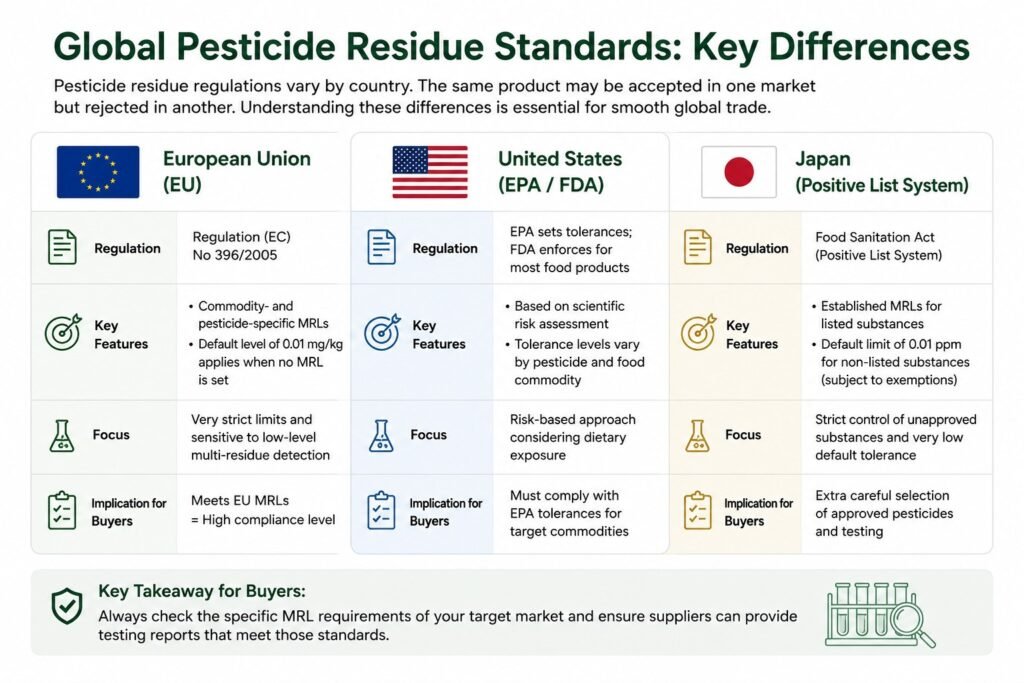
The European Union sets pesticide- and commodity-specific MRLs under Regulation (EC) No 396/2005. When no specific MRL exists, a default level of 0.01 mg/kg generally applies. Buyers must still check the exact fruit and pesticide combination because the legal limit can vary by commodity.
2.2 United States
In the United States, the Environmental Protection Agency sets pesticide tolerances for food. Relevant federal agencies monitor and enforce those limits according to product category. A tolerance for one commodity does not automatically apply to another.
2.3 Japan
Japan uses a Positive List System. Where no specific standard exists, a uniform limit of 0.01 ppm generally applies, subject to relevant classifications and exemptions. This system makes pre-shipment review especially important for products made from concentrated fruit solids.
The same raw material lot may pass in one market and fail in another. A supplier should therefore confirm the destination market before assigning raw material to production.
3. How Freeze-Drying Affects Residue Evaluation
Freeze-drying removes most of the water, but it does not reliably remove pesticide residues. The finished product weighs much less, so residues may become more concentrated on a weight basis. The concentration factor depends on the fresh fruit water content and the final moisture level.
For example, about ten kilograms of fresh fruit may produce one kilogram of freeze-dried fruit. In that case, a residue in the fresh material may appear at a much higher level in the final product. Not every compound follows a perfect ten-to-one ratio. Processing behavior, sampling variation, and analytical uncertainty also matter. Even so, the drying ratio must form part of the risk assessment.
The safest approach is to compare raw material results with the intended finished-product specification. Buyers should not rely only on the fresh-fruit limit. This approach helps prevent a lot from passing at intake but failing after dehydration.
4. A Practical Control System from Farm to Shipment
4.1 Farm and Source Control
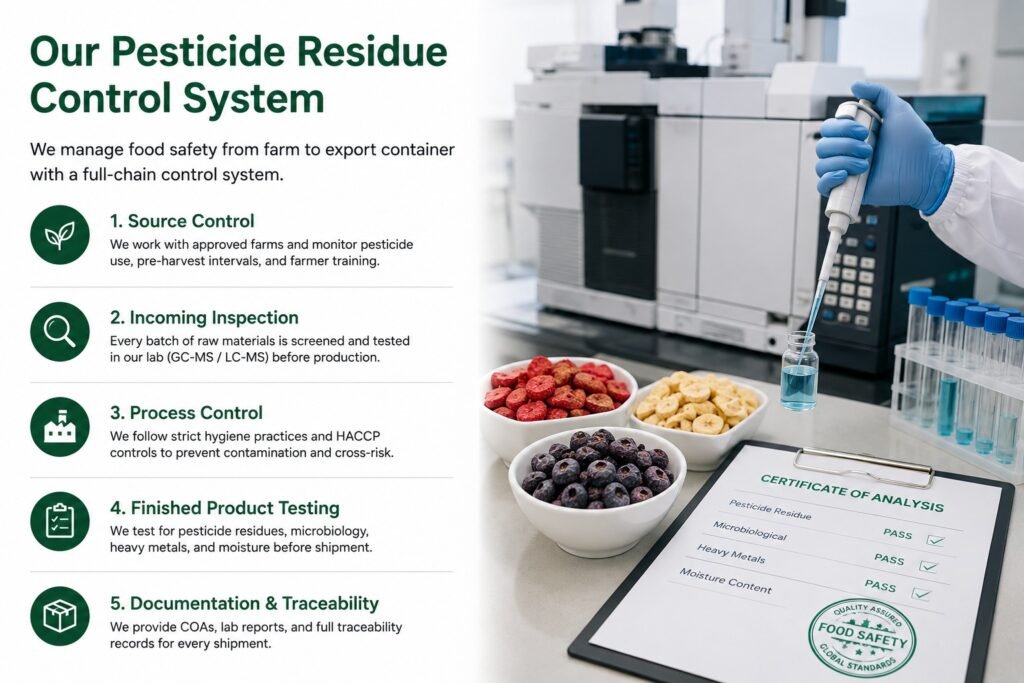
An effective control system starts with approved growing areas and documented pesticide use. Supplier qualification should cover farm identity, crop history, approved agrochemicals, application records, and pre-harvest intervals. These records reduce uncertainty before the fruit reaches the factory.
4.2 Incoming Material Control
Incoming inspection should combine visual checks, identity verification, and risk-based residue testing. The factory should block materials that fail the agreed standard. It should also preserve lot identity through washing, cutting, freezing, freeze-drying, grading, and packing.
4.3 Finished-Product Release
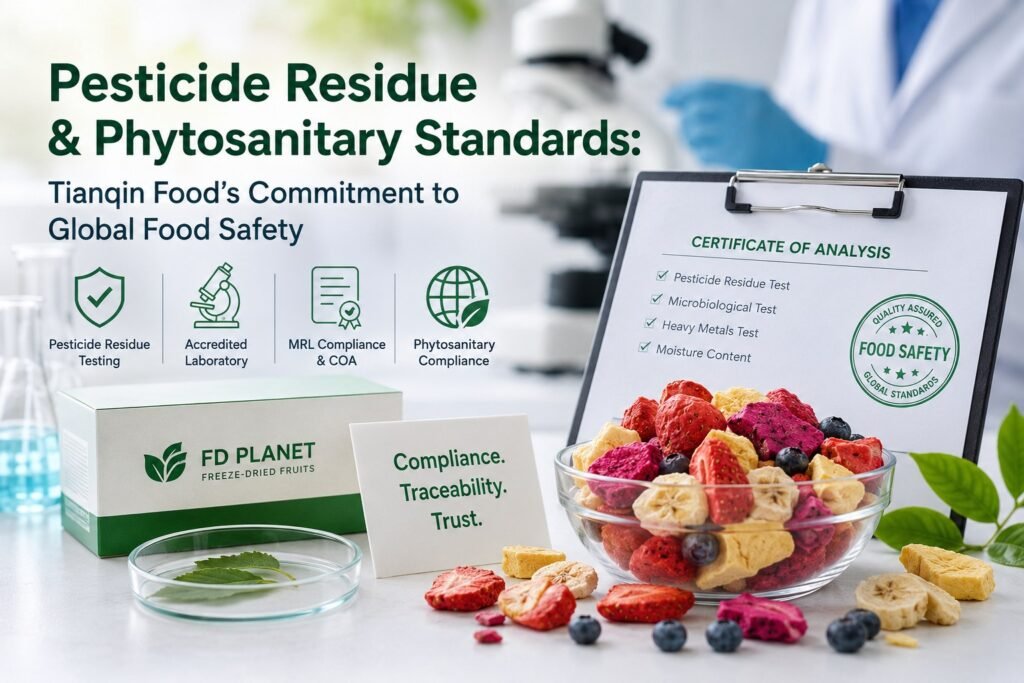
Finished-product release should follow the customer agreement. A batch CoA may cover routine parameters such as moisture, water activity, particle size, and microbiology. Accredited third-party reports may support pesticide residue, heavy metal, or other agreed tests. A factory CoA and a third-party test report are different documents, so suppliers should present them clearly.
5. What Phytosanitary Compliance Actually Covers
Phytosanitary compliance focuses on regulated plant pests and the risk that a shipment could introduce them into another country. It is separate from routine microbiological testing for food safety. A phytosanitary certificate confirms that a shipment meets the importing country plant-health requirements.
Not every processed fruit product needs a phytosanitary certificate. The requirement depends on the product, processing status, HS classification, destination country, and current import rules. Buyers and suppliers should confirm the requirement before shipment instead of assuming that all freeze-dried fruit follows one rule.
Some markets may require inspection, treatment, an additional declaration, or specific packaging controls. Fumigation is not a routine default for every freeze-dried fruit shipment. Any treatment must match the official import requirement and suit the product.
6. Storage, Hygiene, and Pest Prevention
Low water activity helps limit microbial growth during storage, but freeze-drying is not a sterilization process. Good hygiene, validated cleaning, environmental controls, and pest management remain essential.
Warehouses should keep raw materials and finished products dry, sealed, and protected from pests. Packaging materials and containers should be clean and free from visible contamination. Before loading, the team should check container cleanliness, dryness, odor, and structural condition.
7. Traceability and Documentation Buyers Should Verify
A reliable traceability system should connect the finished lot with the raw material source, receiving date, production line, processing record, test results, and shipment documents. The supplier should retrieve this information quickly during a complaint or audit.
Before placing a commercial order, buyers should ask five practical questions:
- Which market standard applies?
- How did the supplier select the test panel?
- Did the risk assessment include the drying ratio?
- Which reports will the supplier issue for each lot?
- Does the product need a phytosanitary certificate or another import document?
8. FD Planet’s Approach to Export Compliance
At FD Planet, we treat compliance as a product-specific and market-specific process. Before production, we review the destination market, customer specification, raw material risk, and required documents. This approach is more reliable than applying one generic standard to every order.
Our objective is simple: select suitable raw material, preserve lot identity, test against the agreed risk profile, and provide documents that match the lot supplied. When requirements change, the control plan must change as well.
Conclusion: Compliance Is Market Access
For freeze-dried fruit, pesticide residue testing and phytosanitary compliance are not last-minute paperwork. They begin with the source fruit and continue through production, testing, documentation, and export review.
The strongest supplier does not promise that every batch will automatically meet every market. A reliable supplier identifies the correct standard, explains the testing logic, controls the risk, and provides traceable evidence for the lot delivered.
Reference Notes
- European Union: Regulation (EC) No 396/2005 sets pesticide MRLs and generally applies a default level of 0.01 mg/kg where no specific MRL exists.
- United States: The U.S. Environmental Protection Agency sets pesticide tolerances for food.
- Japan: The Positive List System generally applies a uniform limit of 0.01 ppm where no specific standard exists, subject to applicable rules.
- Phytosanitary certification: IPPC ISPM 12 provides requirements and guidance for phytosanitary certificates.
- Regulatory requirements can change. Confirm current limits and import documents for the exact product and destination before shipment.