
FD Planet · Linyi Tianqin Foodstuff Co., Ltd. · Est. 1997
Something structural has changed in the food market over the past decade, and it is visible on any supermarket shelf. Products that used to occupy a specialty health-food niche — short ingredient lists, minimal processing, recognizable components — now occupy premium positioning across mainstream retail. The customer buying freeze-dried fruit snacks at an airport convenience store today is not the same demographic that discovered them in a health co-op fifteen years ago. The category has moved, and it has moved fast.
For food brands — whether they are launching a new SKU, extending a private-label range, or reformulating an existing product — this shift creates both a clear opportunity and a specific sourcing challenge. The opportunity is in the ingredient itself: freeze-dried fruit carries the consumer story that the market is asking for. The challenge is finding a supplier whose production capability is actually matched to the scale and consistency that a commercial product line requires.
This article looks at both sides of that equation — the demand conditions that have made freeze-dried fruit a strategically important ingredient category, and what brand builders should understand about supply before they commit to it as a product foundation.
1. What the Market Is Actually Asking For
The dominant force reshaping the premium food market right now is not a single demographic — it is a convergence of expectations across multiple consumer cohorts who have arrived at roughly the same purchasing behavior from different directions.
Transparency as the New Premium Signal
A decade ago, “premium” in food largely meant higher-quality processing — better flavors, more interesting formats, fancier packaging. The definition has shifted. For a growing segment of consumers across most developed markets, premium now signals restraint: fewer ingredients, less processing, more recognizable inputs. The product that reads “freeze-dried strawberry” as its sole ingredient carries a different quality signal than one with a twelve-component stabilizer system — regardless of which one tastes better in a blind test.
This is not a niche preference. Research consistently shows that a significant proportion of premium food purchasers now read ingredient lists before making a buying decision, and that the length and legibility of that list directly influences their perception of product quality. For food brands operating in snack, confectionery, breakfast, or functional nutrition categories, this has practical implications for ingredient selection that go beyond taste and cost.
The Clean Label Constraint as a Formulation Opportunity
For product developers, the clean label requirement functions as a constraint — but it is one that freeze-dried fruit is unusually well-positioned to solve. A freeze-dried strawberry piece, incorporated into a granola bar or a chocolate tablet, adds color, flavor, and nutritional character while keeping the ingredient declaration simple. There are no carriers, no anti-caking agents, no artificial color enhancers, no preservatives. The label reads exactly what the product contains.
This is increasingly difficult to replicate with alternatives. Flavoring systems that provide “strawberry” character in a processed product typically involve several components — flavor compounds, carrier systems, colorants — each of which adds length and complexity to the ingredient list. Natural fruit concentrates and purees often require stabilizers to function in a shelf-stable matrix. Freeze-dried fruit, applied in piece or powder format, delivers the sensory outcome with a one-line declaration.
The strategic value of this is not merely marketing. In markets with evolving regulatory frameworks around natural claims — the EU’s ongoing review of “natural flavoring” definitions, the UK’s post-Brexit labeling standards, the FDA’s clean label guidance in the US — having an ingredient that is unambiguously a single processed fruit rather than a multi-component flavoring system reduces compliance risk across jurisdictions.
2. Where Freeze-Dried Fruit Fits in the Current Product Landscape
Private-label freeze-dried fruit products: one of the fastest-growing formats in premium retail across European and North American markets
The categories where freeze-dried fruit is seeing the most commercial momentum are not all the ones that get the most industry coverage. Chocolate confectionery gets significant attention — and the growth is real — but the more structurally significant expansion is happening in categories where freeze-dried fruit solves a formulation problem that previously had no clean-label answer.
Private Label: The Fastest-Growing Demand Channel
Major European retailers — particularly in the UK, Germany, the Netherlands, and the Nordic markets — have significantly expanded their private-label premium snack ranges over the past three years. Freeze-dried fruit features prominently in this expansion, both as standalone snack products and as inclusions in composite products like trail mixes, granola, and specialty cereals.
For retailers developing these ranges, the commercial logic is straightforward: freeze-dried fruit products carry high gross margin potential, align with the clean-label positioning that drives their premium tier, and require relatively low minimum order quantities for market testing compared to co-manufactured composite products. The challenge is sourcing at the consistency and volume required to support a retail listing — which demands a supplier relationship with genuine production depth rather than a trader offering spot-market availability.
The private-label opportunity also creates a specific requirement around packaging flexibility. Retailers building a coherent premium range need to specify their own labeling, their own weight formats, and sometimes their own blend ratios. This is possible only when the supplier relationship is direct with the manufacturer — not mediated through an ingredient trading desk that resells a fixed product menu.
Functional Nutrition: The Emerging Category
Freeze-dried fruit powder is accumulating a second commercial life in functional nutrition categories that barely registered as meaningful markets five years ago. Collagen drink mixes, adaptogen blends, greens powders, and high-protein snack formats are all increasingly incorporating freeze-dried fruit powder as a natural flavor and color component — alongside its function as a genuine nutritional input.
The mechanics of this are straightforward. Freeze-drying concentrates not just flavor but the full nutritional profile of the source fruit. Freeze-dried strawberry powder delivers measurable vitamin C and polyphenol content per gram, not just strawberry taste. For brands making functional claims — or brands positioning in a functional-adjacent space without making specific claims — this dual function (flavor plus nutrition) carries genuine formulation value.
The growing importance of this category also raises sourcing requirements. Brands with functional positioning typically need verified per-lot nutrient content data — not nominal published values — because consumer trust in their claims depends on consistency, and consistency depends on documented per-batch analysis from the production side. Suppliers who issue meaningful CoA data per lot, rather than general product specification sheets, are the functional nutrition category’s natural supply partners.
Foodservice and Hospitality: The Under-Discussed Channel
Premium hotel breakfast programs, boutique café chains, and airline catering have been steady adopters of freeze-dried fruit, but the channel has attracted relatively little sourcing-focused analysis. The requirement here is different from retail: smaller order volumes, higher SKU variety, faster turnaround, and emphasis on visual presentation over unit economics.
Freeze-dried mango slices on a hotel breakfast buffet serve a different function than freeze-dried mango pieces in a snack bar — but both require the same underlying ingredient quality. Color uniformity, structural integrity, and consistent flavor intensity matter as much to a chef designing a plated dessert as they do to a production manager running a bar-forming line. Suppliers whose quality framework is built for industrial buyers can serve foodservice buyers too; suppliers who have only ever worked in spot-market foodservice cannot easily scale to industrial supply.
3. Building a Product Range: What Variety Depth Actually Enables
One of the less-discussed competitive advantages in the freeze-dried fruit category is the ability to build a coherent product range from a single supplier rather than managing multiple sourcing relationships for different varieties. For food brands, this has direct operational value: unified quality standards, consistent documentation formats, coordinated lead times, and a single point of accountability for specification compliance.
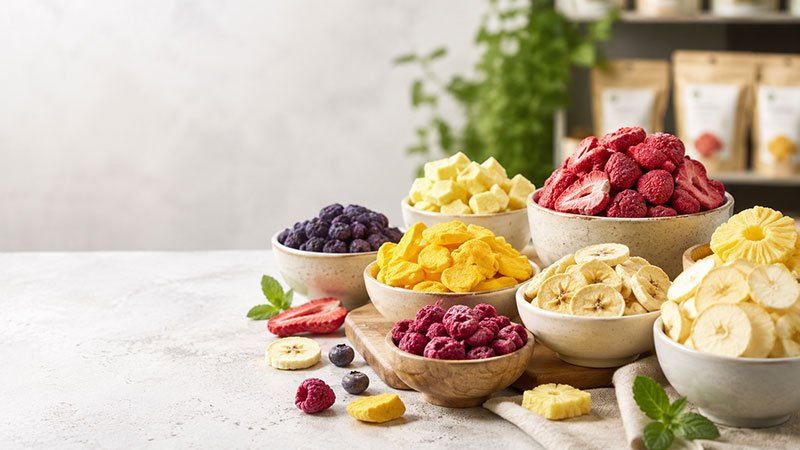
At FD Planet, producing strawberry, blueberry, mango, raspberry, apple, banana, and pineapple across dedicated production lines means that a brand building a product range — a trail mix with three fruit components, or a chocolate collection across four flavor variants — can specify and receive all components under the same quality framework. The CoA format is consistent. The water activity testing methodology is consistent. The particle size specification language is consistent. These are not cosmetic advantages; they directly reduce the quality management overhead for the buying organization.
Format Flexibility Across Varieties
Each variety is available in multiple formats — whole or sliced pieces, diced granules, and powder — and the appropriate format is not always the obvious choice for a given application. Mango in powder format delivers intense tropical flavor and natural yellow-orange pigmentation in a dry mix; mango in large pieces creates visual impact in a premium snack or confectionery product. Both come from the same production facility, processed to the same incoming material standard, documented under the same quality system.
For product developers working across multiple formats within a single range, this means specification work done once at the supplier level — raw material sourcing standards, cycle parameters, moisture targets — translates across the entire range. The development investment is not duplicated for each variety.
New Variety Development and Seasonal Planning
Brands building a long-term product strategy in the freeze-dried fruit category benefit from a supplier relationship that includes forward planning conversations, not just order fulfillment. Raw material seasonality means that optimal harvest windows for different fruits — strawberry peaks in early summer across European sourcing zones, mango peaks in spring-summer across South and Southeast Asian zones — create natural opportunities for brands to position seasonal limited editions or to lock in pricing ahead of demand peaks.
A supplier with cold storage infrastructure and established grower relationships can support this kind of strategic planning. A trader working purely on spot-market procurement cannot offer advance pricing visibility or guaranteed availability outside the standard harvest window. For brands operating in premium retail where seasonal NPD is a margin opportunity, this distinction is commercially meaningful.
4. The Supply Side of a Consumer Trend: What Brand Builders Need to Verify
Consumer-facing demand trends are only commercially useful if the supply chain behind them is reliable enough to support a retail listing. The freeze-dried fruit category has experienced periods of acute supply stress — most notably between 2021 and 2023, when a combination of raw material shortages, energy cost escalation, and demand spikes created allocation failures across multiple suppliers globally. Brands that had committed to freeze-dried fruit as a hero ingredient in a listed product found themselves managing supply gaps they could not communicate publicly.
The lesson from that period is structural: consumer demand trends are not supply guarantees. A growing market does not automatically produce a reliable supply base. For brands evaluating the freeze-dried fruit category as a strategic ingredient platform, the supply-side due diligence is as important as the trend analysis.
Indicators of Production Depth
The operational characteristics that distinguish a manufacturer capable of supporting a commercial product range from one suited only to sample and trial orders are not always visible in a product specification sheet. They show up in conversations about how production is structured:
Number of independent production lines: Multiple lines running in parallel create genuine redundancy. A single-line operation cannot absorb maintenance, recalibration, or raw material disruption without affecting all customer allocations simultaneously.
Dedicated vs. multi-category facilities: A facility built specifically for freeze-drying, rather than a general food processing plant with freeze-drying capacity added, is structured around the quality requirements of the process. Cross-contamination controls, environmental monitoring, and allergen management are all more straightforward in a dedicated facility.
Cold storage and raw material inventory: The ability to purchase raw material at optimal harvest and hold it to processing schedule — rather than producing to spot-market availability — is a direct determinant of ingredient consistency and pricing stability.
Institutional history: Suppliers who have been in continuous food ingredient production since before the current demand cycle — Linyi Tianqin has operated since 1997, beginning in air-dried seasonings before expanding into freeze-drying — carry operational experience that newer entrants attracted by the current premium cycle do not have.
Documentation Standards That Support a Premium Brand
Premium brand positioning creates documentation requirements beyond standard food safety compliance. Brands selling into European retail — particularly UK grocery, German discounters moving into premium, and Nordic specialty chains — face retailer-driven audit requirements that specify documentation formats, CoA scope, and traceability depth that exceed BRC or FSSC baseline requirements.
For a supplier relationship to support these requirements, the documentation infrastructure must already exist at the production level — not be assembled retroactively in response to a retailer audit request. Per-lot CoA covering moisture, water activity, color index, particle size, microbial profile, and pesticide residue panel; batch-level traceability from finished product to incoming raw material lot; retention sample management for a minimum 24-month period — these are standard expectations for a supplier serving premium European retail channels.
Closing Thought
The consumer demand shift toward transparent, minimally processed ingredients is not a trend cycle — it is a structural market reorientation that has been building for over a decade and shows no sign of reversal. Freeze-dried fruit sits at the intersection of that demand shift with genuine functional ingredient capability: it delivers real sensory performance, a defensible clean label, and a premium positioning story that works in multiple product categories simultaneously.
For brands building in this space, the sourcing decision is the product decision. The consistency of what goes into your formulation determines the consistency of what your customers experience. At FD Planet, we have spent nearly three decades building the production infrastructure — three facilities, six dedicated freeze-drying lines, German-engineered chamber technology, and grower relationships that predate the current demand cycle — to be the kind of manufacturer that makes that sourcing decision straightforward.
FD Planet | Linyi Tianqin Food Co., Ltd. | Established 1997 | Freeze-Dried Fruit Manufacturer
Looking for a Reliable Freeze-Dried Fruit Supplier?
FD Planet supports brands, private-label buyers, and food manufacturers with freeze-dried fruit in whole, sliced, diced, granule, and powder formats.
Contact us to discuss specifications, samples, MOQ, and supply planning.