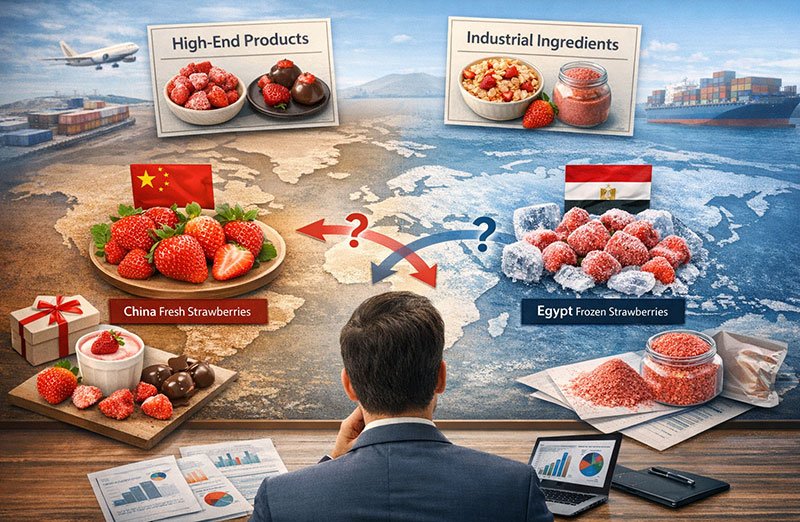
The global freeze-dried strawberry market is expanding rapidly, driven by demand from premium snack brands, infant food manufacturers, bakery ingredient suppliers, and functional food producers. For importers targeting the European Union, Japan, or the United States, one principle must be established before any discussion of varieties, harvest windows, or pricing: only raw materials that pass the pesticide residue and heavy metal standards of the destination market can be considered. Compliance is not a final checkpoint — it is the starting point of every sourcing decision.
This guide provides a comprehensive breakdown of major strawberry varieties sourced from China and Egypt, their optimal ripening periods, and the best procurement windows for freeze-dried products — all filtered through the lens of export food safety compliance.
Part 1: Why Food Safety Compliance Must Come First
The Structural Problem With Chinese Strawberry Supply Chains
China is the world’s largest strawberry producer, and its freeze-dried processing capacity is extensive. However, the industry carries two persistent vulnerabilities that pose serious risks for export-oriented buyers: pesticide residue non-compliance and heavy metal contamination.
In March 2026, a major food safety investigation by China’s leading investigative media outlet exposed systemic violations across the Yunnan province freeze-dried strawberry supply chain. Cadmium levels in finished freeze-dried products reached 0.728 mg/kg — nearly 14.6 times over China’s own national limit of 0.05 mg/kg. The investigation further found that over 20 types of out-of-scope pesticides were detected in a single batch, including the highly toxic carbofuran, a compound banned for use on fruit crops in China and classified as a restricted substance in most major export markets.
The root causes are structural. Strawberry is a shallow-rooted plant that absorbs heavy metals — particularly cadmium — from topsoil with high efficiency. Intensive use of low-grade phosphate fertilizers and proximity to industrial zones accelerates accumulation. The freeze-drying process then concentrates these contaminants in the final product, multiplying the risk relative to fresh fruit readings.
Compounding this, the industry’s “multi-farm aggregation” model — where processors collect raw fruit from dozens of smallholder growers without meaningful traceability — makes lot-by-lot compliance almost impossible to guarantee. The investigation also revealed a widespread practice of maintaining separate “testing-only” farms growing chemical-free fruit exclusively for inspection submission, while commercial volumes were sourced from non-compliant farms.
Key Risk: A supplier presenting a clean test report does not confirm that the commercial shipment matches the tested sample. Independent third-party testing of the actual export lot is non-negotiable.
The EU, Japan, and US Compliance Landscape
EU Standards (EC Regulation 396/2005): The EU operates the world’s most comprehensive maximum residue level (MRL) framework, covering hundreds of active substances for strawberries. Unlisted pesticides default to a 0.01 mg/kg universal limit. Many fungicides and insecticides widely used in Chinese strawberry cultivation are EU-prohibited or carry sub-0.01 mg/kg MRLs. This makes EU compliance the most difficult bar to clear — and the most useful baseline for multi-market procurement strategies.
Japan (Positive List System): Introduced in 2006, Japan’s system applies a default 0.01 ppm limit to any substance not explicitly listed. Japan maintains stricter individual limits than the EU for certain organophosphate and carbamate compounds that are common in Chinese growing practices.
US Standards (EPA/FDA): The US framework is generally more permissive on overall MRLs but enforces absolute zero tolerance on specific banned substances including carbofuran. The FDA’s import alert system means a single non-compliant shipment can trigger enhanced scrutiny for all subsequent imports from a supplier.
Practical Strategy: Source and specify to EU MRL standards. Products compliant with EU requirements will, in almost all cases, satisfy Japanese and US requirements simultaneously.
Part 2: Egypt as a Preferred Compliant Source
Against the backdrop of China’s supply chain compliance challenges, Egypt has emerged as a strategically important alternative source — not primarily because of price, but because of its comparatively lower food safety risk profile for export-oriented procurement.
Why Egypt Offers Lower Compliance Risk
Egypt’s primary strawberry growing regions in the Nile Delta — including Qalyubia and Kafr el-Sheikh governorates — benefit from alluvial soils with naturally lower heavy metal baselines compared to degraded industrial-era farmland in parts of China. Irrigation water is sourced predominantly from the Nile system with relatively limited industrial contamination in major farming areas.
Critically, Egypt has maintained strawberry exports to the EU as a major revenue stream for decades. European importers have worked directly with Egyptian growers to implement crop protection programs that align with EU prohibited substance lists. A significant proportion of Egyptian growing operations with EU export history apply integrated pest management (IPM) protocols and avoid compounds flagged under EU Regulation 396/2005.
This does not mean Egyptian strawberries are inherently compliant — independent verification remains essential — but it means the probability of encountering EU-prohibited substances is substantially lower than in unverified Chinese supply chains.
Egyptian Varieties, Harvest Windows, and Freeze-Dried (FD) Procurement Timing
Egypt primarily cultivates Festival, Camarosa, and Sweet Charlie varieties in its major production zones.
| Variety | Characteristics | Peak Harvest | FD Procurement Window |
| Festival | Large firm fruit, bright red, balanced sugar-acid, high commercial yield | Dec – Feb | Jan – Mar |
| Camarosa | Deep red, firm, good shelf life, slightly higher acidity, robust processing performance | Nov – Feb | Dec – Mar |
| Sweet Charlie | High sugar content, softer flesh, excellent aroma, strong FD color retention | Nov – Jan | Dec – Feb |
Egyptian freeze-dried strawberry products are primarily available between December and April, with peak availability and best pricing in January and February when raw material supply is at its highest.
Part 3: Chinese Varieties — Compliance Profile and Procurement Windows
1. Honeoye (US-13)
Origin: USA (introduced to China in 1986). Primary growing regions: Shandong Province (Linyi, Weifang, Rizhao).
Key Characteristics: Large conical fruit averaging 30g, with some specimens exceeding 100g. Deep red color with high gloss. Soluble solids approximately 11%. Distinctively high acidity relative to sugar content. Firm flesh with excellent processing durability — low breakage during freeze-drying, high slice integrity.
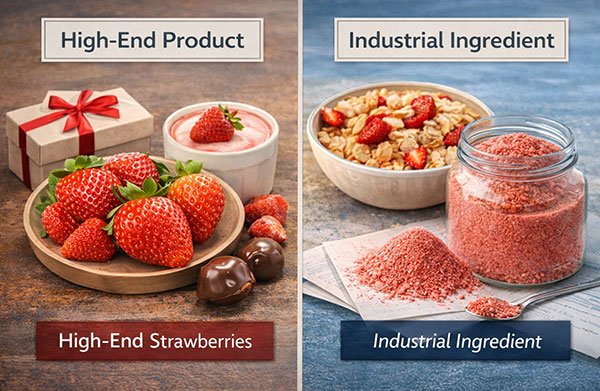
Why Honeoye is Preferred in Japanese B2B Markets: Honeoye’s primary export appeal — particularly for Japanese buyers — stems from its pronounced acidity, not from sweetness. Japanese industrial food applications, including strawberry-dipped chocolate, yogurt coatings, pastry fillings, and biscuit inclusions, require an ingredient that counterbalances the sweetness of the carrier medium. High-acid Honeoye creates a sharp, defined strawberry flavor contrast that high-sweetness, low-acid varieties like Benihoppe or Akihime cannot replicate in these formulations. This makes Honeoye a B2B ingredient variety, not a direct-to-consumer snack variety.
Positioning Note: Honeoye freeze-dried strawberry should be positioned and sold as an industrial food ingredient for confectionery, bakery, and dairy applications — not as a premium eating snack. Target buyers are professional food manufacturers, not end consumers.
Compliance Profile: Shandong has a longer tradition of export-oriented agricultural production (historically for Japan and Korea) compared to Yunnan. Some Linyi and Weifang operations have documented export history and existing residue management protocols. Risk is lower than Yunnan province but independent lot-testing against EU/Japan MRL panels remains mandatory.
Peak Harvest: Late April to early June (open field). FD Procurement Window: May to July.
2. Benihoppe (Hongyan)
Origin: Japan (introduced 1999). Primary regions: Dandong (Liaoning), Anhui (Changfeng), Shandong.
High sugar, low-medium acid, strong fragrance, elongated conical form. China’s most widely cultivated commercial variety. Dandong Benihoppe from large-scale registered farms with Japan/Korea export track records has relatively better risk management in place. Greenhouse-forced Benihoppe from unverified origins carries higher pesticide risk due to the extended growing cycle requiring more disease interventions.
Peak harvest (Dandong open field): May–June. FD procurement window: Late May–July. Peak harvest (Anhui/Shandong greenhouse): December–March. FD procurement window: January–April.
3. Sweet Charlie
Origin: USA. Primary regions: Yunnan (altitude/off-season), Hubei, Anhui.
Important: Yunnan-origin Sweet Charlie carries the highest compliance risk among all Chinese production zones following the 2026 cadmium scandal. Until systematic soil remediation and independent baseline heavy metal surveys are completed across Yunnan growing areas, Yunnan-origin material should be treated as high-risk and excluded from EU/Japan/US export supply chains unless accompanied by independent soil AND finished product testing.
Hubei and Anhui Sweet Charlie carries lower (though not eliminated) heavy metal risk. FD procurement window: December–April (greenhouse forced).
4. Akihime (Zhangji)
Origin: Japan. Primary regions: Sichuan (Chengdu), Zhejiang (Jiande).
Extremely high sugar, very low acid, soft flesh, exceptional fragrance — often described as “cream strawberry.” Delicate skin makes fresh transport impractical, making local freeze-drying the logical application. High aroma retention in freeze-dried format is a distinguishing advantage for premium confectionery use. FD procurement window: January–April. Advance booking by December is recommended.
5. Miaoxiang 7
A domestically bred Chinese variety with high flesh firmness, strong disease resistance, and lower processing losses. FD procurement window: May–July (Liaoning/Shandong). Suitable for price-sensitive bulk ingredient procurement.
Part 4: Annual Procurement Calendar
| Period | Recommended Source | Variety/Origin | Compliance Priority |
| Nov – Dec | Egypt | Festival / Camarosa | High — established EU export protocols |
| Jan – Mar | Egypt (peak) | Festival / Sweet Charlie | High — peak quality and availability |
| Jan – Apr | China (Sichuan) | Akihime | Medium — independent test required |
| Jan – Apr | China (Anhui/Hubei) | Sweet Charlie (non-Yunnan) | Medium — verify soil baseline data |
| May – Jul | China (Dandong) | Benihoppe / Miaoxiang 7 | Medium — prefer farms with JP/KR export history |
| May – Jul | China (Shandong) | Honeoye (Mei-13) | Medium — B2B industrial buyers, test required |
| Aug – Oct | China (Yunnan) | Sweet Charlie | LOW — HIGH RISK, avoid for EU/JP/US export |
Part 5: Building a Compliant Procurement Framework
1st Step – Supplier Qualification
- GlobalG.A.P. or equivalent Good Agricultural Practice (GAP) certification
- ISO 22000 or FSSC 22000 food safety management certification
- Documented export history to EU, Japan, or equivalent regulated markets
- Full lot traceability to named growing farms, not aggregated regions
2nd Step- Pre-Season Baseline Verification
- Commission independent soil heavy metal surveys (Cd, Pb, Hg, As) before raw material commitment
- Review historical pesticide application records for contracted farms
- For Chinese-origin material: confirm no proximity to former mining, smelting, or industrial sites
3rd Step – Finished Product Testing
- Engage accredited independent laboratories (SGS, Eurofins, Intertek) for EU MRL full-panel pesticide residue testing
- Include heavy metals panel on every export lot
- Require test reports on the commercial lot — not a reference sample — before releasing payment
4th Step – Contractual Risk Allocation
- Specify pesticide and heavy metal limits numerically in purchase contracts
- Include indemnification clauses covering port detention, destruction costs, and downstream recall expenses
- Require supplier disclosure of all sub-suppliers and contracted farms
Conclusion
The freeze-dried strawberry procurement landscape for EU, Japan, and US markets is defined by a fundamental tension: China offers scale, variety, and processing capacity, but its supply chain carries structural food safety risks that require active management. Egypt offers a lower-risk entry point for the critical winter sourcing window, backed by years of EU export discipline.
Among Chinese varieties, Honeoye (Mei-13) from Shandong stands out as a specifically valuable option for Japanese and European B2B confectionery and bakery customers — valued precisely for its high acidity rather than sweetness. Benihoppe from Dandong represents the premium positioning end of the market. Both require rigorous independent verification.
The most resilient procurement strategy combines Egyptian winter supply with carefully verified Chinese spring supply, underpinned by independent third-party testing at every lot release point. In export markets where a single non-compliant shipment can result in import bans, multi-year brand damage, or customer recalls, the cost of this verification framework is always justified.
Target Keywords: freeze-dried strawberry import | freeze-dried strawberry procurement | pesticide residue freeze-dried strawberry | EU MRL strawberry | Honeoye strawberry export | Egypt strawberry freeze-dried | freeze-dried strawberry varieties China