
Freeze-dried fruit applications are expanding rapidly in two demanding categories: sports nutrition and children’s food. On the surface, they have little in common. Sports nutrition is built around performance claims, macronutrient ratios, and consumers who read labels for protein and carbohydrate content. Children’s food is built around parental trust, texture safety, and a consumer — the child — who has no direct role in the purchase decision.
What they share is a structural demand for ingredients that do something real, in a format that survives the realities of manufacturing and shelf life, without depending on additives that either category’s core audience has learned to be wary of. Freeze-dried fruit meets that demand more often than it fails it — but the failure modes are specific to each category, and they are not the same failure modes. A supplier or product developer who treats freeze-dried fruit as interchangeable between a recovery bar and a toddler snack is working with an incomplete picture of what each application actually requires.
This article examines freeze-dried fruit applications in both categories: what the ingredient does well, where its technical and regulatory limitations appear, and what food brands should verify when sourcing freeze-dried fruit for sports nutrition or children’s products.
FD Planet · Linyi Tianqin Foodstuff Co., Ltd. · Est. 1997
1. Sports Nutrition: Where Function Has to Show Up on the Label
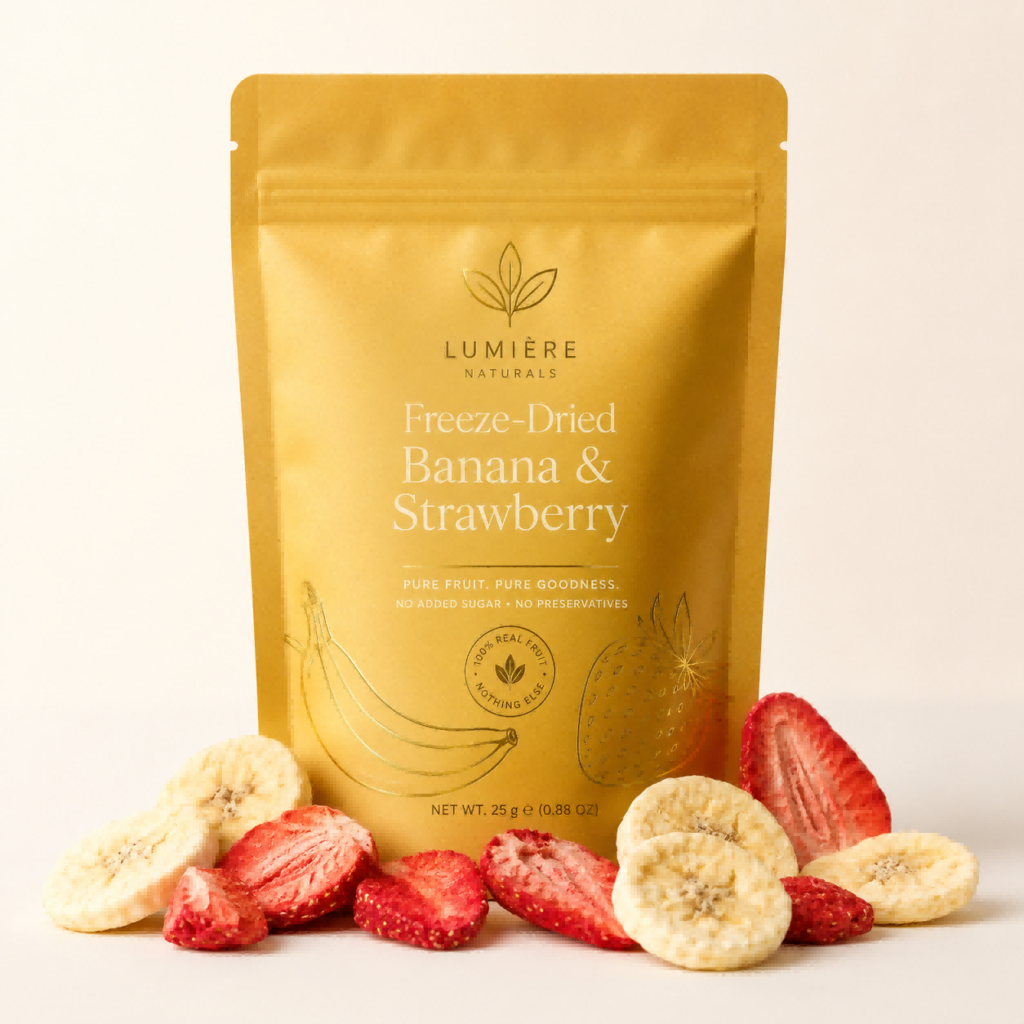
The sports nutrition category has matured past its early identity as a market for synthetic, heavily processed products aimed exclusively at bodybuilders. A large share of current growth comes from a broader population — recreational runners, cyclists, gym-goers, and people who think of “performance nutrition” as part of an active lifestyle rather than a competitive one. This audience reads labels with the same scrutiny as any other health-conscious consumer, and increasingly expects performance products to look and taste like food, not like a chemistry set.
Carbohydrate Density and Energy Format
Freeze-dried fruit’s most direct functional contribution to sports nutrition is carbohydrate density in a low-weight, shelf-stable format. A gram of freeze-dried mango or banana delivers close to the same carbohydrate and natural sugar content as several grams of the fresh fruit, because the water — which makes up 80-90% of the fresh weight — has been removed without removing the sugars, fibre, or micronutrients.
This matters specifically for endurance applications: energy chews, trail mix formats for hiking and cycling, and recovery bars where the carbohydrate-to-weight ratio determines how much fuel an athlete can carry. Banana, in particular, has become a staple in this space because its carbohydrate profile — including resistant starch and natural sugars in a ratio that supports sustained energy release — closely matches what sports nutrition formulators are trying to achieve with synthetic carbohydrate blends, but with a recognisable ingredient name.
Electrolyte and Micronutrient Carriers
Freeze-dried fruit retains a meaningful share of the vitamin and mineral content present in the fresh fruit — particularly potassium, which is a relevant electrolyte for endurance athletes managing sweat loss during prolonged exercise. Freeze-dried banana and freeze-dried strawberry both carry potassium content that, while not at the concentration of a dedicated electrolyte supplement, contributes meaningfully when used at realistic inclusion rates in a recovery product.
This has created a specific formulation niche: products that position freeze-dried fruit not just as a flavour or texture component, but as part of the functional claim itself — “naturally sourced potassium” or “real fruit, real electrolytes” framing that differentiates a product from competitors relying entirely on synthetic mineral premixes.
Where It Gets Technically Demanding
The challenge in sports nutrition applications is rarely the fruit itself — it is the matrix it sits in. Recovery bars and energy chews often have intermediate moisture content (water activity in the 0.5–0.65 range) to achieve the chewy texture athletes expect, which is a fundamentally different environment from the low-moisture snack applications where freeze-dried fruit performs most predictably.
In this intermediate-moisture environment, freeze-dried fruit pieces will absorb moisture from the surrounding matrix over shelf life. If the product is formulated and tested without accounting for this, the result is freeze-dried fruit pieces that start crisp at production and become soft or chewy within weeks — which may actually be acceptable, or even desirable, in a chewy bar format, but only if it was a designed outcome rather than an unplanned one. Specifying freeze-dried fruit for this application means understanding the target equilibrium moisture of the finished product and selecting a piece size and structure that performs acceptably across that transition, not just at time zero.
Powder formats sidestep this issue almost entirely. Freeze-dried fruit powder blended into a bar matrix or a protein shake does not have a “crisp to chewy” transition to manage — its functional contribution (flavour, colour, micronutrient content) is largely independent of the moisture migration that affects whole pieces. For formulators working in intermediate-moisture matrices, powder is often the more reliable starting point, with whole pieces reserved for low-moisture formats where their textural contribution is the point.
In sports nutrition, the fruit rarely fails. The matrix it’s asked to survive in is what determines whether it performs as intended.
2. Children’s Food: A Different Set of Rules Entirely
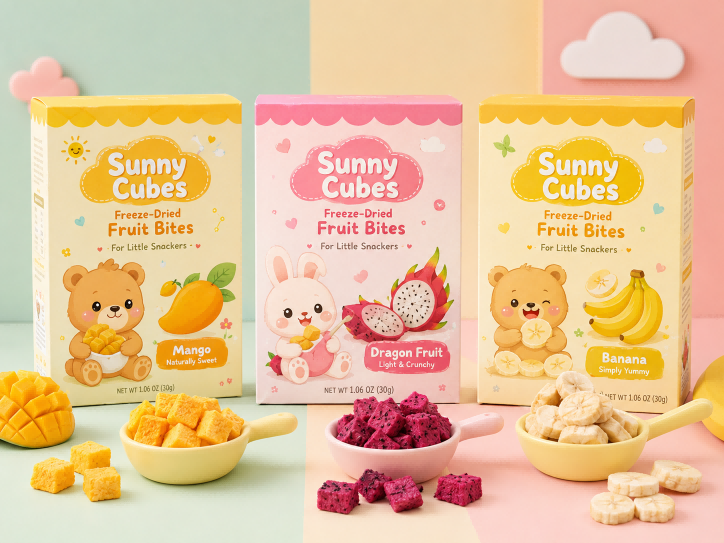
If sports nutrition is about making a functional claim credible, children’s food — particularly products aimed at infants, toddlers, and young children — is about making a safety and trust claim credible, while still creating something a child will actually eat. The regulatory and quality bar in this category is meaningfully higher than in general food manufacturing, and freeze-dried fruit’s strengths and limitations both become more pronounced as a result.
Why Freeze-Dried Fruit Appeals to This Category
The appeal is straightforward from a parent’s perspective: a single-ingredient freeze-dried fruit product — strawberry pieces, banana slices, apple dices — requires no explanation. There is no ingredient to look up, no additive to research, no compound name to be uncertain about. For a category where parental trust is the primary purchase driver and ingredient anxiety is well-documented, that simplicity carries real commercial weight.
Texturally, freeze-dried fruit also solves a problem that conventional dried fruit does not: it dissolves. A freeze-dried strawberry piece placed in a young child’s mouth softens quickly with saliva, in a way that a chewy dried fruit piece — which can pose a choking risk for younger children — does not. This property has made freeze-dried fruit a foundational ingredient in the “melting puff” and “dissolvable snack” category aimed at children from around six months, where a product needs to be soft enough to be safe but structured enough to encourage self-feeding and oral motor development.
Where the Bar Is Genuinely Higher
The regulatory framework for infant and toddler food is considerably stricter than for general food products, and this affects sourcing decisions in ways that are easy to underestimate. Pesticide residue limits for products marketed to infants and young children are typically a fraction of the limits that apply to general food — in many regulatory frameworks, an order of magnitude lower. A raw material lot that would pass standard food-grade testing without issue can fail the limits applicable to an infant-food formulation.
This means that sourcing freeze-dried fruit for children’s food categories is not simply a matter of selecting from an existing product range. It requires raw material that was grown, monitored, and tested against the stricter standard from the outset — which in practice means either dedicated raw material sourcing programmes for this category, or testing every lot against the infant-food threshold regardless of its intended end use, so that lots meeting the higher bar can be allocated accordingly.
Allergen management is the second area where the bar rises. While fruit itself is rarely a primary allergen, cross-contact risk in a shared production facility — particularly with tree nuts, which are common co-ingredients in snack and cereal products run on the same equipment — requires documented control measures that go beyond what general food manufacturing typically implements. For a children’s food brand, the question to ask a freeze-dried fruit supplier is not only what is in the product, but what else runs on the same production line, and what the changeover and cleaning validation protocol looks like between runs.
Portion Format and Particle Size
Particle size specification for children’s food is driven by safety considerations that do not apply in adult snack formats. A piece size appropriate for an adult trail mix may present a choking hazard in a product aimed at toddlers. This typically means smaller, more uniform particle sizes, often combined with a softer or more friable structure that breaks down easily under minimal pressure — a structural property that, again, comes back to freeze-drying process parameters specific to each fruit variety, since a banana piece and an apple piece do not fracture the same way under the same force.
In children’s food, the fruit has to be more than clean-label. It has to be provably grown, tested, and processed to a standard the category’s regulators — and its parents — actually require.
What This Means for Sourcing — Across Both Categories
The common thread across freeze-dried fruit applications in sports nutrition and children’s food, despite their different requirements, is that both categories punish inconsistency more severely than mainstream snack applications do. A sports nutrition brand that has built a product around “naturally sourced potassium from real banana” cannot afford a batch where the freeze-dried banana’s nutrient retention varies significantly from the values used to support that claim. A children’s food brand cannot afford a raw material lot that passes general food-grade testing but would not pass the infant-food threshold, if that lot ends up allocated to the wrong production run.
Process Consistency as a Nutritional Claim Foundation
Nutrient retention in freeze-dried fruit depends on the freeze-drying cycle being run correctly for that variety — not just on the raw material’s starting nutrient content. Excessive thermal exposure during the drying cycle, even within a process that technically qualifies as “freeze-drying,” can degrade heat-sensitive vitamins and reduce the nutrient density that a sports nutrition or children’s food brand may be relying on for a label claim. This is one of the reasons why running each fruit variety on parameters specifically developed for it — rather than a generic cycle — matters beyond texture and colour. It also protects the nutritional integrity that underpins the claims these categories are built on.
Documentation That Supports the Claim, Not Just the Product
For both categories, the documentation a supplier can provide needs to extend beyond a standard CoA. Sports nutrition brands making specific micronutrient claims benefit from suppliers who can provide nutrient analysis data — not just generic published values — for the specific varieties and lots they are sourcing. Children’s food brands need suppliers who can demonstrate, with testing records, that raw material sourcing and lot testing protocols meet the stricter residue thresholds applicable to their category, not just general food-grade standards.
At FD Planet, producing across seven fruit varieties — strawberry, blueberry, raspberry, mango, apple, banana, and pineapple — on six independent 200-metre production lines equipped with German-engineered freeze-drying chambers allows for the kind of per-variety process control that both of these categories depend on. Operating since 1997, with three dedicated production facilities including one purpose-built for freeze-drying, gives us the raw material sourcing relationships and testing infrastructure to support category-specific requirements rather than offering a single undifferentiated product line.
Conclusion: Choosing Freeze-Dried Fruit for Demanding Applications
Sports nutrition and children’s food are two of the most demanding categories freeze-dried fruit is used in — not because the ingredient is unsuited to either, but because both categories have built consumer trust on promises that depend on the ingredient performing exactly as represented, batch after batch. A recovery product that claims real-fruit electrolytes, or a toddler snack that claims a single clean ingredient grown and tested to infant-food standards, is making a promise that starts in the freeze-drying facility, not on the packaging line.
For brands developing in either space — or both — the sourcing conversation needs to go beyond moisture content and particle size. It needs to cover nutrient retention data, raw material testing against the relevant regulatory threshold, and process documentation specific to the fruit variety in question. That is the conversation FD Planet is built to have.
FD Planet | Linyi Tianqin Food Co., Ltd. | Established 1997 | fdplanet.com
Talk to FD Planet About Your Application
FD Planet supplies freeze-dried strawberry, blueberry, raspberry, mango, apple, banana, and pineapple in whole, sliced, diced, granule, and powder formats. Contact us to discuss application requirements, particle size, testing standards, documentation, samples, and supply planning.