What Freeze-Drying Really Does to Blueberries
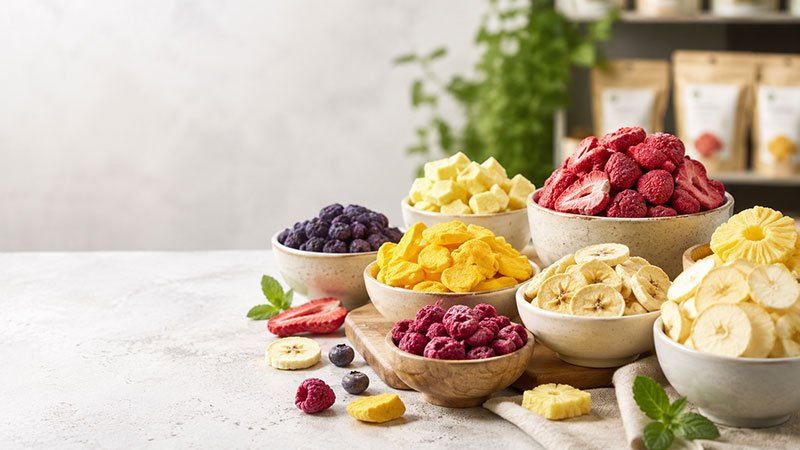
Freeze-drying is widely regarded as one of the most effective preservation techniques for blueberries, particularly when the goal is to retain bioactive compounds, natural color, and structural integrity. During freeze-drying, fresh blueberries are frozen and exposed to a high-vacuum environment, allowing ice to sublimate directly into vapor without passing through the liquid phase.
For freeze-dried blueberries, this process minimizes thermal stress and limits water-mediated degradation reactions. As a result, freeze dried blueberry ingredients often maintain higher levels of sensitive compounds—such as anthocyanins—than products dried using conventional hot-air or drum-drying methods.
However, freeze-drying does not mean “zero damage.” The porous microstructure formed during sublimation makes FD blueberries lightweight and highly rehydratable, but also more vulnerable to oxygen and moisture during post-processing and storage. Understanding this balance is key to evaluating the true value of freeze-dried blueberry products.
Anthocyanins: The Functional Core of Freeze-Dried Blueberry Ingredients
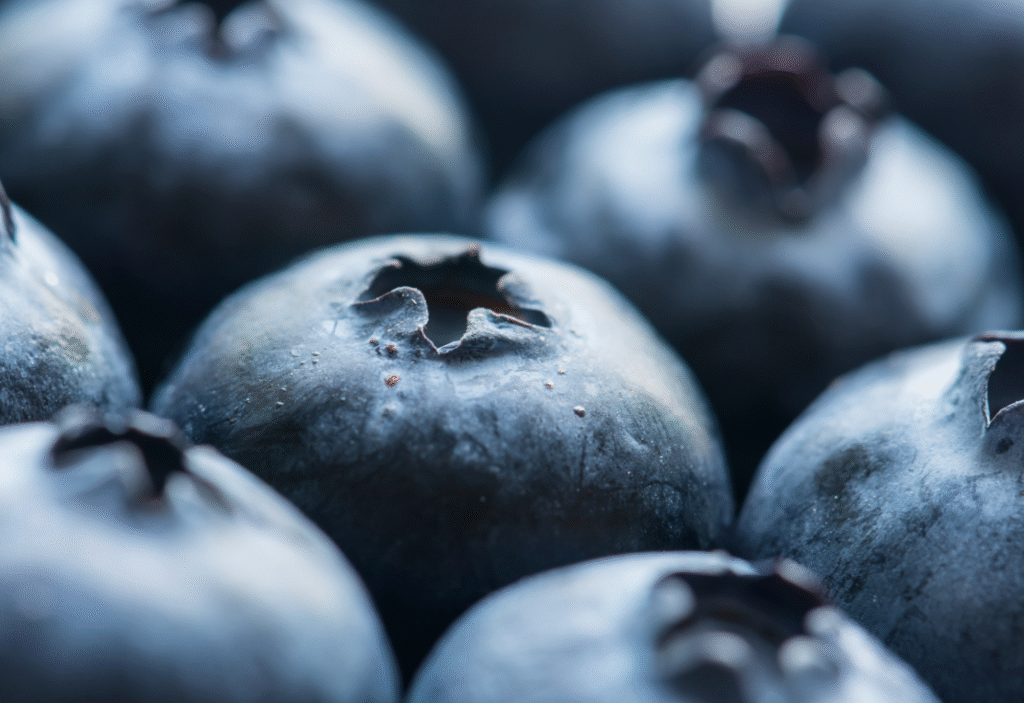
Anthocyanins are the natural pigments responsible for the deep blue and purple coloration of blueberries. They are also among the most researched polyphenols due to their antioxidant behavior and role in plant defense.
In both fresh and freeze-dried blueberries, anthocyanins are primarily concentrated in the berry skin rather than the flesh. This distribution has practical consequences: any processing step that disrupts the skin—such as milling into freeze dried blueberry powder—can increase surface exposure and accelerate degradation if not properly controlled.
Anthocyanins are particularly sensitive to:
- Oxygen exposure
- Light
- Elevated moisture levels
- Higher storage temperatures
Because of this, the stability of anthocyanins in FD blueberry powders depends as much on packaging and storage as on the freeze-drying process itself.
Anthocyanin Retention in Freeze-Dried Blueberries
When discussing anthocyanin retention in freeze-dried blueberry products, it is important to clarify how values are measured. Removal of water during freeze-drying concentrates solids, which can make anthocyanin levels appear higher on a per-gram basis compared to fresh fruit.
More meaningful evaluations compare anthocyanin retention on a dry-weight basis or per fresh-fruit equivalent. Under controlled conditions, freeze-dried blueberries generally retain a significant proportion of their original anthocyanins, especially when oxygen exposure during drying and handling is minimized.
Key processing factors influencing retention include:
- Freezing rate and ice crystal formation
- Drying shelf temperature and cycle duration
- Oxygen exposure during unloading and milling
- Whether the product remains whole or is converted into FD blueberry powder
Whole freeze-dried blueberries typically show better long-term anthocyanin stability than finely milled powders due to reduced surface area.
Structure Stability: Why Freeze-Dried Blueberries Change Over Time
The defining structural feature of freeze-dried blueberries is their highly porous internal matrix. This “air-scaffold” structure explains many desirable properties—crisp texture, rapid rehydration, and strong flavor release—but it also creates stability challenges.
Moisture Sensitivity and Hygroscopic Behavior
Both freeze dried blueberry powder and FD blueberries readily absorb moisture from the environment. As moisture content increases, molecular mobility within the dried matrix rises, accelerating pigment degradation and leading to:
- Loss of crunch
- Powder clumping and caking
- Color fading
- Reduced shelf life
This behavior is closely linked to the concept of glass transition temperature (Tg). Once absorbed moisture lowers Tg below storage temperature, the material becomes less stable and more reactive.
Packaging and Storage of Freeze-Dried Blueberry Products
The long-term quality of freeze-dried blueberries depends heavily on post-drying handling. Even a well-processed FD blueberry ingredient can deteriorate quickly if packaging is inadequate.
Effective storage strategies focus on:
- Maintaining low water activity
- Using high-barrier packaging materials
- Limiting oxygen exposure
- Protecting products from light
For freeze dried blueberry powder, these factors are even more critical due to the increased surface area created during milling. In many commercial settings, nitrogen flushing and moisture-barrier laminates are used to extend shelf life at room temperature.
Food Applications of Freeze-Dried Blueberries
Bakery, Cereals, and Snack Products
Whole freeze-dried blueberries are widely used in cereals, granola, and baked goods where visual identity and fruit texture are important. However, moisture migration from surrounding ingredients can soften the berries over time, particularly in bars and soft-baked products.
Dairy and Beverage Applications
Freeze dried blueberry powder disperses quickly in yogurt, smoothies, and dry beverage mixes. Its rapid rehydration provides strong color and flavor impact, though formulation pH and storage humidity play key roles in maintaining pigment stability.
Confectionery and Gummies
In confectionery systems, FD blueberry powders are often used for both flavor and natural color contribution. Stability depends heavily on matrix composition, processing temperature, and final water activity.
Beyond Food: Nutraceutical and Functional Uses
Outside conventional foods, freeze-dried blueberry ingredients are increasingly used in:
- Capsules and tablets
- Functional blends and sachets
- Cosmetic and personal care formulations
- Research and pilot-scale product development
In these applications, standardization becomes essential. Buyers often evaluate FD blueberries based on anthocyanin profile, moisture content, particle size, and batch-to-batch consistency rather than flavor alone.
Quality Parameters That Matter When Sourcing FD Blueberries
For manufacturers and formulators, meaningful specifications include:
- Moisture content and water activity
- Total anthocyanins and anthocyanin profile
- Color metrics (L*, a*, b*)
- Particle size distribution for powders
- Packaging format and oxygen protection
Testing freeze-dried blueberry ingredients in the final product matrix is strongly recommended, as stability can change once the ingredient interacts with proteins, sugars, or acids.
FAQs
1. Are freeze-dried blueberries always nutritionally superior?
They often retain more sensitive compounds than heat-dried alternatives, but retention depends on processing control and storage conditions.
2. Why does freeze dried blueberry powder clump easily?
Because FD blueberry powders are hygroscopic and absorb moisture, which lowers glass transition temperature and increases stickiness.
3. Is whole freeze-dried blueberry more stable than powder?
In most cases, yes. Whole freeze-dried blueberries have lower surface area exposure than powders.
4. Can FD blueberries be used as natural colorants?
They can contribute natural purple-blue hues, but color stability depends on pH, light exposure, and moisture control.
5. What storage condition is most critical?
Low and stable humidity is the single most important factor for preserving anthocyanins in freeze-dried blueberry products.
6. Are FD blueberry ingredients suitable for supplements?
Yes, especially when standardized and properly packaged to protect against oxidation and moisture.
Conclusion
The real value of freeze-dried blueberries, whether as whole fruit, freeze dried blueberry powder, or FD blueberry ingredients, lies in a balance of chemistry, structure, and application design. Freeze-drying offers excellent potential for anthocyanin retention, but that potential is only realized when structural stability, packaging, and formulation are carefully managed.
For brands and manufacturers, understanding how FD blueberries behave over time—rather than assuming freeze-drying alone guarantees stability—is the key to delivering consistent quality and long-term value.